Longevity & Cellular Aging
CAS
175175-23-2
Molecular Weight
418
Da
A synthetic tripeptide developed by Vladimir Khavinson's group at the St. Petersburg Institute of Bioregulation and Gerontology. Research focuses on neuroprotection, antioxidant activity, and cognitive preservation in aging models. Evidence base is preclinical and originates almost entirely from one research institution. No independent human trials. Shares the same Russian literature caveats as Epitalon and Semax.
Injectable · Nasal
Intranasal Suitable
Yes
Research Compound
We break down one compound like this every week.
Subscribe free to The Honest Dose, and get the RQS Reference, every compound in the catalog scored on one page, as a welcome gift.
Community signal is minimal. Pinealon is one of the least-discussed compounds in the catalog even within biohacking communities. It occupies a similar niche to Epitalon (Russian peptide, longevity framing) but with even less accumulated anecdotal history. Most discussion is theoretical, referencing the pineal gland and sleep-wake regulation rather than personal experience reports. Users interested in Pinealon are typically already deep in the Russian peptide literature (Khavinson peptide bioregulator framework) and approach it as part of a broader organ-specific peptide protocol. The extremely low RQS score (10/100) makes sense given the compound's low profile.
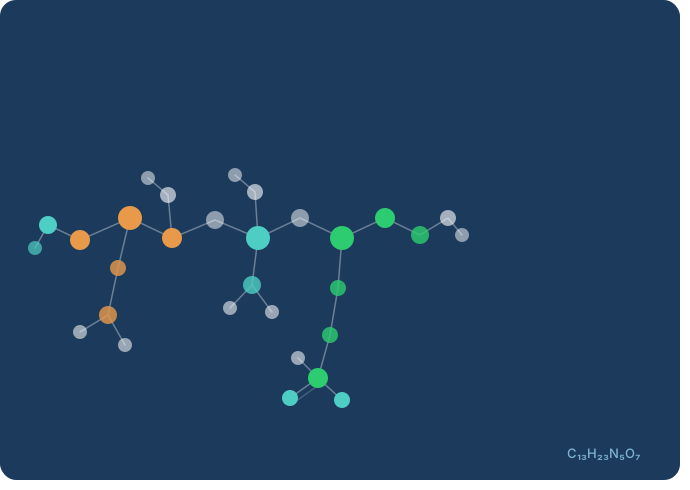
Pinealon is a synthetic tripeptide. It was developed by Vladimir Khavinson's group at the St. Petersburg Institute of Bioregulation and Gerontology as part of a broader framework of short peptide bioregulators, compounds proposed to regulate gene expression in specific tissue types by interacting directly with DNA promoter regions. Pinealon's target tissue is the central nervous system and pineal gland. It is closely related to Epitalon (also a Khavinson-group compound) but differs in sequence, target, and proposed primary mechanism, where Epitalon focuses on telomerase activation, Pinealon's research centers on neuroprotection and CNS gene expression modulation. Both share the same provenance caveat: the evidence base originates almost entirely from affiliated Russian laboratories.
Khavinson's proposed mechanism for Pinealon and related bioregulators is direct peptide-DNA interaction, specifically that short peptides bind to promoter regions of target genes and modulate transcription. In the case of Pinealon, this is proposed to regulate expression of neuroprotective genes in CNS tissue. In vitro studies using neural cell lines under hypoxic or oxidative stress conditions report reduced apoptotic markers, improved cell viability, and antioxidant activity following Pinealon exposure. Rodent ischemia models show reduced infarct volume and improved behavioral outcomes. A 2017 study documented neuroprotective effects in a mouse model of Huntington's disease. A 2021 paper in Pharmaceuticals examined tripeptide epigenetic regulators including Pinealon in an Alzheimer's disease mouse model.
Preclinical only. Published research documents antioxidant effects in neural cell cultures, neuroprotection in rodent ischemia and hypoxia models, reduced apoptosis markers in aging brain tissue, and behavioral improvements in aged rats under stress conditions. A 2019 study examined cognitive rehabilitation effects in aging rhesus macaques. Community use includes cognitive enhancement and neuroprotection stacking with Epitalon and Semax, but human evidence is absent. The Russian literature note that applies to Epitalon, Semax, and Selank applies equally here, lower journal impact factors reflect the publishing context, not necessarily the quality of the underlying science, but independent replication outside the Khavinson group remains very limited.
No human safety data from controlled trials. The preclinical safety profile appears benign at research doses. As a tripeptide, systemic degradation is expected to be rapid. No known contraindications documented in the literature, but the absence of human trial data means the complete risk profile is unknown.
Available from research suppliers as lyophilized powder for reconstitution. Some vendors offer intranasal formulations. No approved pharmaceutical formulation. Not available through regulated clinical channels.
Not approved by the FDA or any Western regulatory body. Used in some Russian clinical contexts under the broader Khavinson bioregulator framework, but no equivalent approval exists in the US, EU, or UK. Research compound only in Western markets.
https://pmc.ncbi.nlm.nih.gov/articles/PMC7795577/
https://pubmed.ncbi.nlm.nih.gov/21978084/
https://pubmed.ncbi.nlm.nih.gov/26390612/
Enjoyed this profile? Get one compound broken down in depth every week in The Honest Dose.
Last Reviewed