Longevity & Cellular Aging
CAS
1094-61-7
Molecular Weight
334
Da
A direct precursor to NAD+, the coenzyme central to cellular energy production, DNA repair, and aging biology. NAD+ declines with age across tissues. Multiple human RCTs confirm oral NMN reliably raises blood NAD+ levels. Whether elevated NAD+ translates to meaningful anti-aging outcomes in humans remains an open question, the mechanism is solid, the clinical evidence is early. OTC supplement, widely available.
Oral · Powder
Intranasal Suitable
No
OTC Supplement
We break down one compound like this every week.
Subscribe free to The Honest Dose, and get the RQS Reference, every compound in the catalog scored on one page, as a welcome gift.
Community signal is high-volume and increasingly sophisticated. NMN sits at the intersection of mainstream longevity interest and serious biohacking, producing a large and diverse anecdotal pool. r/longevity, r/Biohackers, and r/Supplements all contain extensive NMN discussion. Energy and subjective vitality are the most commonly reported effects, particularly in users over 40. The David Sinclair association drives significant community interest, and the community is increasingly aware of the debate around NMN vs NR vs NAD+ precursor effectiveness. Timing and dosing debates are active, particularly around morning vs evening administration and whether TMG should be co-supplemented. The community has become more critical of efficacy claims as the initial hype cycle matures.
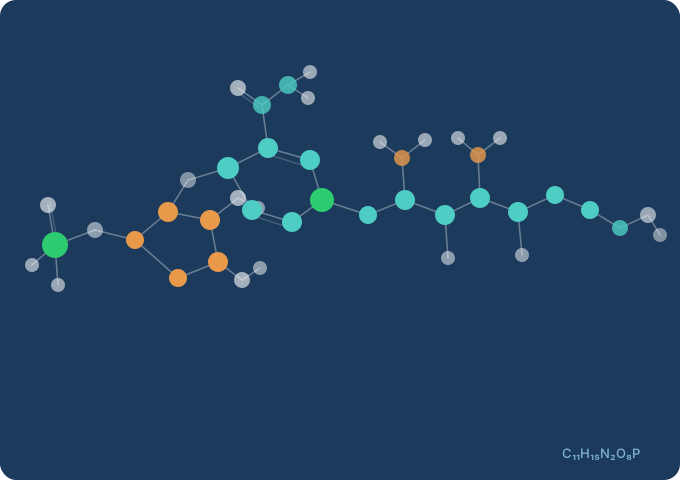
Nicotinamide mononucleotide (NMN) is a naturally occurring nucleotide found in small quantities in foods such as edamame, broccoli, and beef (approximately 1mg per 100g). It serves as a direct precursor to NAD+ (nicotinamide adenine dinucleotide), a coenzyme essential for cellular energy metabolism, DNA repair, gene expression regulation, and sirtuin activation. NAD+ concentrations in human skin, blood, liver, muscle, and brain decline measurably with age, a phenomenon linked to reduced mitochondrial efficiency, impaired DNA repair, and increased susceptibility to age-related disease. The rationale for NMN supplementation is straightforward: raise NAD+ levels by providing a bioavailable precursor. The scientific interest, spurred heavily by David Sinclair's lab at Harvard and others, has produced a growing body of human trial data that distinguishes NMN from most compounds in the longevity category.
NMN is converted to NAD+ via the Preiss-Handler pathway and the salvage pathway, primarily through the enzyme NMNAT (NMN adenylyltransferase). Elevated NAD+ activates sirtuins (SIRT1-7), a family of NAD+-dependent deacylases involved in mitochondrial biogenesis, stress resistance, inflammation regulation, and circadian rhythm maintenance. NAD+ is also required by PARPs (poly ADP-ribose polymerases) for DNA repair. As NAD+ levels decline with age, sirtuin and PARP activity diminish, contributing to the hallmarks of cellular aging. Oral NMN is absorbed in the small intestine, research has established a dedicated NMN transporter (Slc12a8), and elevates blood NAD+ levels measurably within weeks of supplementation at doses of 250–1250mg daily.
Multiple randomized, placebo-controlled human trials confirm that oral NMN supplementation significantly increases blood NAD+ and NAD+ metabolite concentrations. A 2022 double-blind RCT in healthy older men demonstrated elevated NAD+ at both 6 and 12 weeks with 250mg daily. A May 2024 RCT in adults aged 65–75 found maintained walking speed and improved sleep quality in the NMN group versus placebo at 12 weeks. A 2024 meta-analysis of RCTs found significant overall effects on NAD+ elevation but noted that clinically relevant metabolic outcomes, fasting glucose, lipids, insulin resistance, were not significantly different from placebo in most trials. The honest summary: NMN reliably raises NAD+, but whether that translates to meaningful longevity or metabolic benefits in healthy humans is still being established.
Multiple human trials document a clean safety profile at doses up to 1250mg daily. No significant adverse effects, liver damage, or flushing (unlike niacin) observed. Well tolerated across age groups. Long-term safety beyond 12-week trial windows has not been formally established but no signals of concern have emerged. Individuals on medications affecting NAD+ metabolism should consult a physician.
Widely available as an OTC dietary supplement in oral capsule or powder form. Significant variation in product quality and purity across brands, third-party tested products from reputable manufacturers recommended. Also available in sublingual and liposomal formulations, though evidence that these offer superior bioavailability over standard oral forms is limited. Closely related compound nicotinamide riboside (NR) is an alternative NAD+ precursor with a similar but distinct metabolic pathway and a comparable human trial evidence base.
Regulated as a dietary supplement under DSHEA in the US, though the FDA issued a notification in 2022 that NMN may not qualify as a dietary supplement because it was first studied as a drug, a designation that could affect its legal status. As of 2026, NMN remains widely sold as an OTC supplement with no enforcement action taken. Not a controlled substance. Widely available internationally.
https://pmc.ncbi.nlm.nih.gov/articles/PMC9158788/
https://pmc.ncbi.nlm.nih.gov/articles/PMC10721522/
https://pmc.ncbi.nlm.nih.gov/articles/PMC9036060/
Enjoyed this profile? Get one compound broken down in depth every week in The Honest Dose.
Last Reviewed