Skin & Hair
CAS
616204-22-9
Molecular Weight
889
Da
A synthetic peptide used in topical skincare for its ability to relax facial muscle contractions, marketed as a non-injectable alternative to botulinum toxin. Human RCT data exists but is limited in sample size and largely industry-funded.
Topical · Serum
Intranasal Suitable
No
OTC Supplement
We break down one compound like this every week.
Subscribe free to The Honest Dose, and get the RQS Reference, every compound in the catalog scored on one page, as a welcome gift.
Argireline carries unusually high community signal for a cosmeceutical peptide, driven largely by its presence in mainstream skincare. The Ordinary's 10% Argireline Solution brought it from professional-only formulations into mass-market awareness, and r/SkincareAddiction has accumulated hundreds of threads discussing it. Community sentiment is mixed but directionally positive: users with fair skin and early expression lines report visible softening around the eyes and forehead with consistent use, particularly in combination formulations with Matrixyl (Palmitoyl Tripeptide-1). The skeptical contingent, also well-represented, notes that results feel subtle and disappear quickly when product use stops, consistent with the reversible, mechanism-driven nature of the compound. The "botox in a bottle" framing that circulates on TikTok and beauty media is a persistent source of overclaiming that community members actively push back against. No serious adverse event reports circulate in skincare communities. Notably, Argireline's signal comes primarily from mainstream beauty forums (r/SkincareAddiction, r/DIYBeauty, Beautypedia) rather than peptide-specialist communities, reflecting its cosmeceutical positioning versus the injectable peptide world.
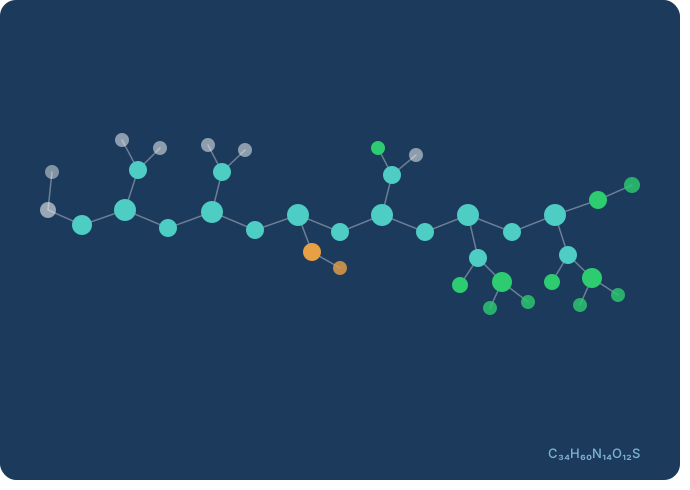
Argireline is a synthetic hexapeptide derived from the N-terminal sequence of SNAP-25, a protein involved in neuromuscular signaling. It was developed by the Spanish cosmeceutical company Lipotec (now part of Lubrizol) and is one of the most widely used cosmeceutical peptides in anti-aging skincare formulations globally.
Argireline competitively inhibits the formation of the SNARE complex, the protein machinery that triggers acetylcholine release at the neuromuscular junction. By partially blocking SNAP-25, it reduces the magnitude of facial muscle contractions, which over time is theorized to soften the appearance of expression lines. The mechanism is functionally analogous to botulinum toxin but is topically applied, reversible, and significantly weaker in effect magnitude. Some studies also suggest secondary effects on matrix metalloproteinase activity and extracellular matrix synthesis.
Reduction of expression lines and wrinkles (particularly forehead and periocular); anti-aging topical formulations; often combined with other cosmeceutical peptides such as Palmitoyl Tripeptide-1 and Leuphasyl (a synergistic compound). Used in serums, eye creams, and targeted treatment products.
Topical argireline has a strong safety profile with no serious adverse events reported in published trials. Mild transient reactions (redness, tingling) are occasionally reported. Theoretical concern exists around systemic absorption with high-concentration formulations, but no clinical evidence of systemic neuromuscular effects has been documented. Not studied in pregnancy or breastfeeding populations.
Argireline is available exclusively as a topical cosmeceutical ingredient. It is not approved or sold in injectable form. Common formulation concentrations range from 2–10% in serums and eye creams. It is widely available OTC as a cosmeceutical ingredient in branded skincare products.
Argireline is classified as a cosmeceutical ingredient and is not regulated as a drug by the FDA in the United States or by the EMA in Europe. It does not require a prescription and is sold freely in skincare products. It is not on any controlled substance list. No FDA IND or NDA has been filed for argireline as a drug product.
https://pubmed.ncbi.nlm.nih.gov/18498523/
https://pubmed.ncbi.nlm.nih.gov/19570099/
https://pmc.ncbi.nlm.nih.gov/articles/PMC11762834/
Enjoyed this profile? Get one compound broken down in depth every week in The Honest Dose.
Last Reviewed