Longevity & Cellular Aging
CAS
307297-39-8
Molecular Weight
390
Da
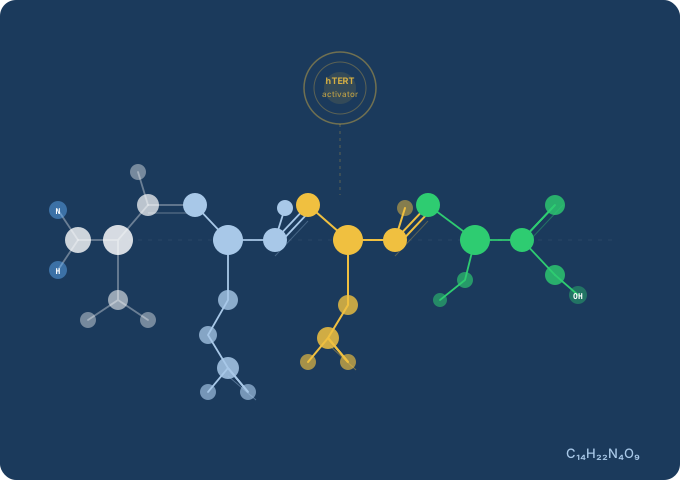
A synthetic tetrapeptide with the sequence Ala-Glu-Asp-Gly — one of the smallest bioactive peptides studied for anti-aging purposes. Developed by Russian gerontologist Vladimir Khavinson at the St. Petersburg Institute of Bioregulation and Gerontology as a synthetic analog of epithalamin, a polypeptide extract from the bovine pineal gland. The most ambitious claim in the catalog — that a four amino acid peptide can activate telomerase, elongate telomeres, restore pineal melatonin production, and extend lifespan. Three decades of primarily Russian research support a genuine mechanistic case. Western independent replication remains limited. Classified as a research compound in most markets though compounding pharmacy access is evolving in 2026.
Injectable · Nasal
Intranasal Suitable
Uncertain
Research Compound
We break down one compound like this every week.
Subscribe free to The Honest Dose, and get the RQS Reference, every compound in the catalog scored on one page, as a welcome gift.
Community signal is moderate and longevity-focused. Epitalon attracts users specifically interested in telomere biology and cellular aging rather than acute performance benefits. r/Longevity and r/Nootropics contain substantive Epitalon threads. The telomerase activation narrative is compelling to the community and drives interest despite the observational-grade evidence. Injected vs nasal routes are debated. Sleep quality and vivid dreaming are frequently reported side effects rather than primary goals, a consistent enough pattern to be notable. Sourcing quality is a concern flagged in negative reports. The Russian origin of the research is known and shapes how the community interprets the evidence, consistent with PeptideClear's Russian Literature Note.
Epitalon (Ala-Glu-Asp-Gly) was engineered by Khavinson's team in the 1980s by identifying the minimal active peptide sequence within epithalamin, a pineal gland extract that had shown life-extending properties in animal studies. The tetrapeptide represents the distillation of the pineal gland's bioregulatory signaling into four amino acids. It belongs to a class of compounds Khavinson calls peptide bioregulators, short peptides proposed to modulate gene expression and restore normal tissue function in aging organisms by binding directly to DNA promoter regions. This gene-regulatory mechanism is unusually direct for a peptide and remains the subject of active scientific debate. Most Epitalon research has been conducted at the St. Petersburg Institute, which creates a concentration-of-source limitation that is important context for evaluating the evidence base.
Epitalon's most studied mechanism is telomerase activation. A landmark 2003 paper by Khavinson et al. reported that Epitalon increased telomerase activity approximately 2.4-fold in human fetal fibroblasts and restored telomerase activity in senescent cells. Treated fibroblasts exceeded the Hayflick limit, undergoing more cell divisions than untreated controls while maintaining telomere length. A 2025 study from an independent Western group confirmed that Epitalon increases telomere length in human cell lines through telomerase upregulation or ALT activity, providing the first meaningful independent replication of this core claim.
The second major mechanism is pineal gland restoration, Epitalon appears to stimulate the pineal gland to produce melatonin, restoring the circadian melatonin rhythm that declines with aging. Since melatonin is a potent antioxidant and circadian regulator, this mechanism has broad downstream implications for sleep quality, oxidative stress, and systemic aging.
Additional mechanisms include epigenetic remodeling, reversal of chromatin aging and histone modulation, and antioxidant pathway upregulation including SOD, NQO1, and catalase. The breadth of proposed mechanisms is consistent with a compound acting at the level of gene expression rather than a specific receptor.
A notable paradox: classic tumor biology associates telomerase activation with increased cancer risk, yet multiple animal studies with Epitalon report reduced tumor incidence including in HER-2/neu breast cancer mouse models. This paradox has not been resolved and represents an important open question in Epitalon research.
Epitalon's primary studied application is longevity and cellular anti-aging. Animal lifespan studies, primarily in mice and fruit flies, have shown statistically significant lifespan extension in Epitalon-treated groups. A study in aging monkeys demonstrated restoration of circadian melatonin rhythms. A small Russian human study showed improved melatonin secretion in elderly patients. These constitute the strongest human data available and are observational in nature.
In the longevity community Epitalon is used in cyclical protocols for telomere maintenance, sleep quality improvement through melatonin restoration, and general cellular anti-aging. It is one of the more academically serious longevity peptides in the catalog given the mechanistic depth of the telomerase activation research.
Antioxidant and DNA protection applications are supported by in vitro data showing reduced oxidative damage and improved genomic stability in aging cells.
All human applications outside the small Russian observational studies should be considered research-grade only. No large-scale Western randomized controlled trials have been completed.
The telomerase activation mechanism raises the most significant theoretical safety concern, telomerase is activated in the majority of human cancers and compounds that upregulate it carry a plausible carcinogenesis risk. This has not been observed in animal studies and some data suggests reduced tumor incidence, creating the paradox noted above. However the human long-term safety data needed to resolve this question definitively does not exist. No significant acute adverse effects have been reported in available studies. The concentration of research from a single Russian institution limits independent safety verification. Research compound only.
Available as a lyophilized sterile powder for reconstitution administered via subcutaneous injection, and as intranasal drops. Injectable is the more commonly used research form given better bioavailability characterization. Research compound only, not available through licensed pharmacies at time of publication. Cyclical administration protocols are common in the research community though no standardized protocol has been established in clinical literature.
Research compound in most markets. No FDA or EMA approval for any therapeutic indication. In a notable 2026 development, on July 24, 2026 the FDA's Pharmacy Compounding Advisory Committee voted, in a close decision, to recommend adding Epitalon to the Section 503A Bulks List, which would allow licensed compounding pharmacies to prepare it by prescription. The vote is advisory and non-binding: the FDA must still complete formal notice-and-comment rulemaking, typically many months, before any change takes legal effect, and Epitalon is not currently available through licensed US compounding pharmacies. PeptideClear will update this profile as the rulemaking develops.
https://pubmed.ncbi.nlm.nih.gov/12937682/
https://pubmed.ncbi.nlm.nih.gov/15452611/
https://pubmed.ncbi.nlm.nih.gov/12209581/
https://pubmed.ncbi.nlm.nih.gov/40908429/
Enjoyed this profile? Get one compound broken down in depth every week in The Honest Dose.
Last Reviewed