Nootropics & Neuroprotection
CAS
330936-69-1
Molecular Weight
2887
Da
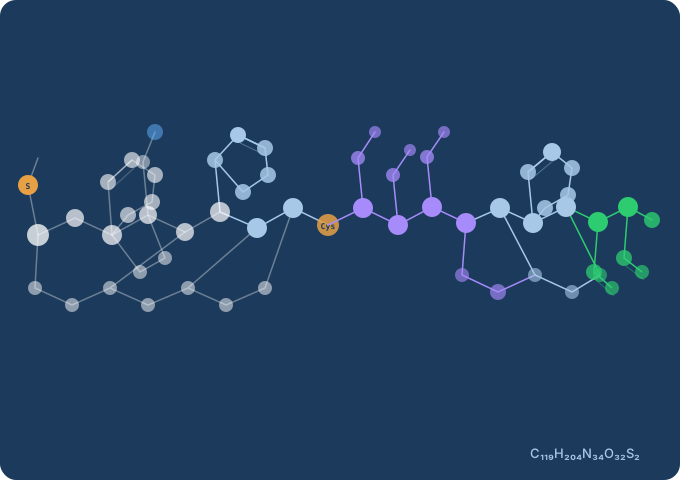
A naturally occurring 24 amino acid peptide encoded by mitochondrial DNA, making it, alongside MOTS-c, one of only two mitochondrial-derived peptides (MDPs) currently covered in this catalog. Discovered in 2001 by Japanese researcher Ikuo Nishimoto through an unbiased cDNA library screen of an Alzheimer's patient's brain, he was searching for survival factors and Humanin emerged as a potent suppressor of neuronal death induced by multiple familial Alzheimer's disease genes. Circulating levels decline with age and in disease states. Studied for neuroprotection, Alzheimer's disease, cardiovascular protection, metabolic regulation, and longevity. No human clinical trials completed. Research compound only.
Injectable
Intranasal Suitable
Uncertain
Research Compound
We break down one compound like this every week.
Subscribe free to The Honest Dose, and get the RQS Reference, every compound in the catalog scored on one page, as a welcome gift.
Community signal is minimal. Humanin is discussed almost exclusively in longevity research circles rather than active user communities. The anecdotal pool is too thin to identify consistent patterns. Those who do discuss personal use are typically biohackers with extensive compound experience who approach Humanin from a mitochondrial or neuroprotective angle. Most community discussion is theoretical, citing the research rather than personal outcomes. The compound lacks the peptide-adjacent community recognition that drives anecdotal accumulation. Users interested in Humanin are generally aware of the animal-only evidence base and approach it with corresponding caution.
Humanin is a 24 amino acid peptide encoded within the 16S ribosomal RNA gene of mitochondrial DNA, the same genomic region that encodes MOTS-c, making them sister compounds from the same mitochondrial locus. Its discovery was serendipitous: Nishimoto's team was screening thousands of brain-derived cDNA sequences for factors that could rescue neurons from Alzheimer's-related death, and Humanin alone abolished that death across multiple disease models. It has since been found in the testis, colon, and brain in vivo, confirming it is produced endogenously rather than being a laboratory artifact. A synthetic analog called HNG (S14G-Humanin), in which serine at position 14 is replaced by glycine, is approximately 1,000 times more potent than native Humanin and is the form most commonly used in research. Pinchas Cohen at USC, the same laboratory that discovered MOTS-c, has been instrumental in characterizing Humanin's role in aging.
Humanin's primary mechanism is cytoprotection through inhibition of apoptosis. It directly interferes with Bax , a pro-apoptotic Bcl-2 family protein, preventing it from triggering the mitochondrial apoptosis cascade. It also binds and inhibits BimEL, another pro-apoptotic protein. This dual anti-apoptotic activity protects neurons, cardiomyocytes, and other cell types from programmed cell death under conditions of oxidative stress, hypoxia, serum deprivation, and amyloid toxicity.
At the receptor level Humanin signals through a cytokine receptor complex involving CNTF receptor alpha, WSX-1, and gp130, activating downstream JAK2/STAT3 signaling pathways that promote cell survival and suppress inflammation. It also demonstrates chaperone-like activity, interfering with misfolded protein aggregation, a mechanism particularly relevant to Alzheimer's disease where amyloid-beta aggregation drives neurodegeneration.
IGFBP-3 has been identified as an extracellular binding partner for Humanin, suggesting it can regulate cell survival through growth factor signaling pathways as well. The breadth of these mechanisms positions Humanin as a master cytoprotective regulator rather than a single-pathway compound.
Humanin's most compelling and extensively studied application is Alzheimer's disease neuroprotection. The original 2001 discovery demonstrated that Humanin abolished neuronal death induced by multiple familial AD genes and amyloid-beta peptides in vitro. Subsequent animal studies confirmed that HNG (the potent analog) attenuates Alzheimer's-like cognitive deficits and pathological changes induced by amyloid-beta in rats. The mechanism, interfering with amyloid toxicity and directly protecting neurons from apoptosis, addresses the core pathology of Alzheimer's disease rather than just symptoms.
Cardiovascular protection is the second most studied application, acute Humanin therapy in mouse models attenuated myocardial ischemia and reperfusion injury significantly, with reductions in infarct size and improved cardiac function. Stroke protection has also been demonstrated in animal models.
Metabolic applications overlap with MOTS-c, Humanin improves insulin sensitivity, reduces obesity markers, and extends healthspan in animal longevity models. Circulating Humanin levels correlate inversely with cardiovascular disease risk in human observational data, and centenarian offspring show higher Humanin levels than age-matched controls, suggesting a role in exceptional longevity.
All current evidence outside the observational human correlation data is from animal and in vitro studies. No human clinical trials have been completed.
No human safety data exists given the absence of clinical trials. Animal studies and in vitro work show a favorable safety profile with no significant adverse effects reported. The anti-apoptotic mechanism raises theoretical concerns about suppressing necessary cell death in contexts where apoptosis is protective, such as early-stage cancer, though no evidence of tumor promotion has been observed in animal studies. Research compound only.
Available as a lyophilized sterile powder for reconstitution in both native Humanin and HNG (S14G) forms. HNG is the preferred research form given its approximately 1,000-fold greater potency relative to native Humanin. Administered via subcutaneous injection in research contexts. No oral formulation, peptide structure limits oral bioavailability. Research compound only.
No regulatory approval from any major health authority. Not available through licensed compounding pharmacies. Research compound only, supplied as lyophilized powder for laboratory use. Not approved or intended for human therapeutic use.
https://pubmed.ncbi.nlm.nih.gov/32575074/
https://pubmed.ncbi.nlm.nih.gov/20651283/
https://pubmed.ncbi.nlm.nih.gov/12732850/
https://pubmed.ncbi.nlm.nih.gov/15655255/
Enjoyed this profile? Get one compound broken down in depth every week in The Honest Dose.
Last Reviewed