Nootropics & Neuroprotection
CAS
62568-57-4
Molecular Weight
849
Da
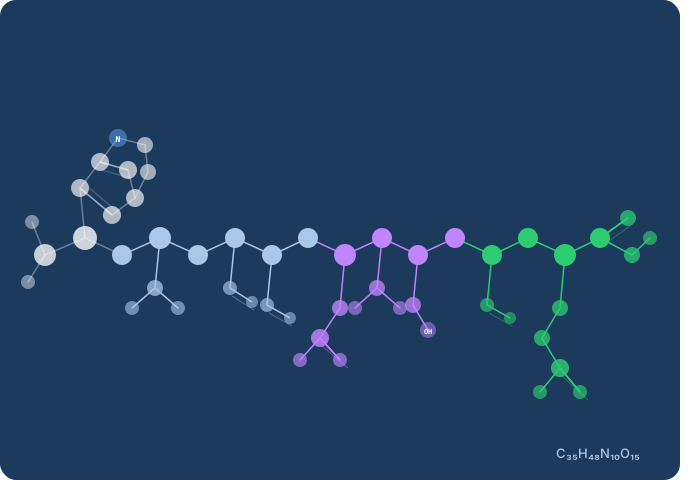
A naturally occurring nonapeptide first isolated from rabbit brain in 1977 by Swiss researchers Monnier and Schönenberger, who discovered it while perfusing the blood of sleeping rabbits into awake rabbits and observing that the awake rabbits fell asleep. DSIP is produced in the hypothalamus and found in minute amounts throughout the brain and bloodstream with marked diurnal variation — low in the morning, higher in the afternoon. One of the most studied sleep-related peptides in existence yet also described in the scientific literature as "a still unresolved riddle." The evidence base is real but genuinely inconsistent, human studies show sleep-promoting effects, but replication has been mixed and the mechanism remains incompletely characterized after nearly 50 years of research.
Injectable · Nasal
Intranasal Suitable
Uncertain
Research Compound
We break down one compound like this every week.
Subscribe free to The Honest Dose, and get the RQS Reference, every compound in the catalog scored on one page, as a welcome gift.
Community signal is sparse and inconsistent, DSIP has an appealing name and concept (Delta Sleep-Inducing Peptide) that generates interest, but user reports don't reliably confirm dramatic sleep improvement. r/Nootropics and r/Peptides threads exist but lack the volume of sleep-focused compounds with stronger evidence. Positive sleep onset and depth reports exist alongside neutral and negative experiences. Sourcing reliability is flagged as a concern, and some skepticism exists about whether commercial products are accurately labeled. The community appears broadly aware that the sleep induction evidence is more equivocal than the compound name implies. Stacking with melatonin and other sleep compounds is common in reported protocols.
DSIP is a nine amino acid peptide with an unusual feature, no precursor gene or structure has been identified, meaning scientists still do not know where in the body DSIP is synthesized. It has an extremely short half-life of only 15 minutes in vitro due to rapid cleavage by a specific aminopeptidase-like enzyme. In the body it is believed to complex with carrier proteins that protect it from degradation. It crosses the blood-brain barrier readily, a rare property for a peptide, which makes it particularly relevant for CNS applications. Plasma concentrations correlate with circadian rhythm in humans and decrease at sleep initiation, suggesting a regulatory rather than simply sedating role. Levels are depressed in patients with Cushing's syndrome alongside reduced delta sleep, linking DSIP to neuroendocrine-sleep axis function.
DSIP's mechanism remains one of the most genuinely unresolved puzzles in peptide neuroscience. Multiple pathways have been identified without a unifying mechanistic framework:
In the brain DSIP appears to act through NMDA receptor modulation, reducing neuronal excitability in a manner consistent with promoting slow-wave sleep without classical sedation. It also stimulates acetyltransferase activity through alpha-1 adrenergic receptors. Perhaps most pharmacologically interesting, DSIP inhibits somatostatin release from the hypothalamus via a dopaminergic mechanism, which secondarily stimulates growth hormone release, explaining the GH-promoting effects observed alongside its sleep effects. Molecular modeling suggests DSIP interacts with the MAPK cascade and shares homology with glucocorticoid-induced leucine zipper protein (GILZ), suggesting a gene-regulatory dimension consistent with its glucocorticoid-regulated plasma levels. The breadth and apparent disconnectedness of these mechanisms has led researchers to propose DSIP may function as part of a larger precursor molecule whose full biology has not yet been characterized.
DSIP's original and primary studied application is slow-wave (delta) sleep induction. The landmark 1982 human study, a double-blind crossover in six healthy volunteers, showed intravenous DSIP at 25 nmol/kg increased total sleep time by 59% within 130 minutes compared to placebo, with improved sleep efficiency and shorter sleep onset on subsequent nights. Critically the study noted no sedation in the classical pharmacological sense, subjects reported sleep pressure rather than drug-induced sedation, suggesting DSIP potentiates natural sleep mechanisms rather than forcing sleep chemically.
Animal studies across rabbits, mice, rats, cats, and humans have consistently demonstrated sleep-promoting activity, though human replication has been inconsistent, some studies show robust effects, others minimal. This inconsistency is the central limitation of the DSIP evidence base and has not been resolved.
Growth hormone stimulation via somatostatin inhibition is a secondary application supported by animal data. Stroke recovery is an emerging application, a 2021 rat study showed intranasal DSIP over 8 days led to accelerated motor function recovery following focal stroke, suggesting neuroprotective properties beyond sleep induction.
In the longevity and biohacking community DSIP is used primarily for sleep quality optimization and jet lag management, the circadian rhythm modulation properties make it particularly interesting for circadian disruption applications.
DSIP has a favorable acute safety profile based on available human and animal data, no significant adverse effects have been reported in published studies. The absence of classical sedation is considered a safety advantage over traditional sleep medications that impair cognitive function and carry dependence risk. The unknown biosynthetic origin and incomplete mechanism characterization create uncertainty about long-term effects that cannot be resolved with current data. The very short half-life limits sustained exposure even with exogenous administration. Research compound only.
Available as a lyophilized sterile powder for reconstitution. The original human studies used intravenous administration but subcutaneous injection is the more practical research route. Intranasal administration has been studied given DSIP's blood-brain barrier permeability, the 2021 stroke recovery study used intranasal delivery specifically. The extremely short half-life of 15 minutes in vitro raises questions about bioavailability for all administration routes, though carrier protein binding in vivo likely extends functional activity significantly. Research compound only.
No regulatory approval from any major health authority. DSIP was one of seven peptides the FDA's Pharmacy Compounding Advisory Committee reviewed for the Section 503A Bulks List on July 23 and 24, 2026, nominated under the name emideltide, and it was the only one the committee voted against, in a close 6 to 7 vote. That recommendation is advisory and non-binding, but it means DSIP was not advanced toward compounding eligibility while six other peptides were. It remains a research compound, not available through licensed compounding pharmacies, not scheduled as a controlled substance in the US, with regulatory status that varies internationally.
https://pubmed.ncbi.nlm.nih.gov/568769/
https://pubmed.ncbi.nlm.nih.gov/6895513/
https://pubmed.ncbi.nlm.nih.gov/2886936/
https://pubmed.ncbi.nlm.nih.gov/16539679/
https://pmc.ncbi.nlm.nih.gov/articles/PMC8434407/
Enjoyed this profile? Get one compound broken down in depth every week in The Honest Dose.
Last Reviewed