Sexual Health
CAS
189691-06-3
Molecular Weight
1025
Da
A synthetic cyclic heptapeptide and melanocortin receptor agonist that received FDA approval on June 21, 2019 under the brand name Vyleesi — making it one of only two FDA-approved treatments for hypoactive sexual desire disorder (HSDD) in premenopausal women and the only peptide in this catalog targeting sexual health. Unlike peripheral vascular agents like PDE5 inhibitors, PT-141 works through a central nervous system mechanism operating through dopamine and nitric oxide pathways independent of direct genital stimulation. Originally discovered as a derivative of Melanotan II when researchers noticed unexpected increases in sexual activity during tanning trials. Requires a prescription through a licensed provider.
Injectable
Intranasal Suitable
Yes
Prescription
We break down one compound like this every week.
Subscribe free to The Honest Dose, and get the RQS Reference, every compound in the catalog scored on one page, as a welcome gift.
Community signal is high-volume and distinct from other compounds in the catalog. PT-141 is discussed in dedicated sexual health communities, relationship forums, and biohacking subreddits, producing a diverse anecdotal pool. Effects on libido and arousal are reported as rapid-onset and notably pronounced by most users, consistent with its mechanism at melanocortin receptors. Nausea is the most commonly flagged side effect, dose-dependent and particularly noted when users exceed recommended amounts. Women's reports are meaningfully represented, an unusual pattern in the peptide community, consistent with Vyleesi's FDA approval in female hypoactive sexual desire. Flushing is frequently reported. The community discussion is notable for its candor relative to the taboo on discussing sexual health supplements openly.
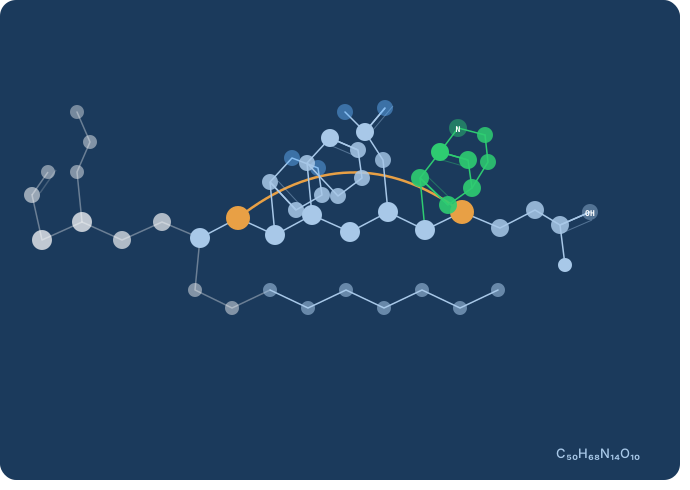
PT-141 is a deaminated derivative and likely metabolite of Melanotan II, another synthetic melanocortin receptor agonist initially used for tanning purposes. During treatment with Melanotan II, researchers, clinicians and patients noticed an increase in sexual activity. This serendipitous observation launched a dedicated research program. The compound is a cyclic peptide, its backbone forms a ring structure via a lactam bond between the aspartic acid and lysine residues, which confers metabolic stability compared to its linear predecessors. It was first described in the literature in 2003 and was investigated for its place in treating sexual dysfunction in men and women but is now only indicated for women. The intranasal formulation was discontinued after concerns about blood pressure elevation, leading to the current subcutaneous autoinjector delivery system marketed as Vyleesi.
PT-141 is an agonist at melanocortin receptors including the MC3R and MC4R, which are expressed primarily in the central nervous system. Of the 5 melanocortin receptors, PT-141 has the highest affinity for melanocortin receptor 4 (MC4R). MC4R activation in the hypothalamus modulates dopaminergic pathways involved in sexual motivation and reward, increasing desire and arousal through central neurological mechanisms rather than peripheral vascular effects. This distinguishes PT-141 fundamentally from PDE5 inhibitors like sildenafil which work by relaxing blood vessels to facilitate physical arousal. PT-141 targets the psychological and motivational dimension of sexual response, desire rather than physical function, making it mechanistically novel in the sexual health pharmacology landscape.
FDA-approved indication is acquired, generalized hypoactive sexual desire disorder in premenopausal women, a condition characterized by persistently low sexual desire causing significant distress, not attributable to relationship problems or other medical conditions. The two pivotal Phase III trials (RECONNECT studies) demonstrated statistically significant improvements in satisfying sexual events and sexual desire scores versus placebo.
Off-label use in men for erectile dysfunction has been studied in clinical trials with positive results, administration of PT-141 to rats and nonhuman primates results in penile erections and human trials showed significant improvement in erectile function. However the FDA approval was not extended to men, in part due to the blood pressure concerns that complicated early development and the availability of established PDE5 inhibitor alternatives.
In the biohacking community PT-141 is used by both men and women for sexual enhancement beyond clinical dysfunction, a use case that is off-label and not supported by the regulatory approval.
The most common adverse effects in clinical trials were nausea (40%), flushing (20%), and injection site reactions. A single case of acute hepatitis occurred in a woman who developed fatigue and weight loss approximately 10 days after receiving her last of 20 doses, with peak ALT 1163 U/L, resolving over the next several months. Transient increases in blood pressure, the complication that ended the intranasal program, can occur with subcutaneous administration and are typically modest and short-lived. Not recommended in patients with cardiovascular disease or uncontrolled hypertension. Not approved during pregnancy. The nausea side effect is significant enough that many clinical patients discontinue use, pre-dosing with an antiemetic is sometimes recommended by prescribers
Available as a single-dose, subcutaneous autoinjector pen (1.75mg/0.3mL) administered in the abdomen or thigh at least 45 minutes before anticipated sexual activity. Not intended for daily use, maximum one dose per 24 hours. The original intranasal formulation was discontinued due to blood pressure concerns. Research compound versions exist in lyophilized powder form through research chemical suppliers, but the FDA-approved Vyleesi autoinjector is the only legitimate prescription-grade formulation. Prescription only.
FDA approved June 2019 (Vyleesi) for acquired, generalized HSDD in premenopausal women. Prescription only. Available through licensed providers and specialty pharmacies. Also available through some telehealth platforms. Not approved for men or postmenopausal women. Off-label prescribing exists at provider discretion.
https://pubmed.ncbi.nlm.nih.gov/12851303/
https://pubmed.ncbi.nlm.nih.gov/27181790/
https://pubmed.ncbi.nlm.nih.gov/31599840/
https://pubmed.ncbi.nlm.nih.gov/31429064/
Enjoyed this profile? Get one compound broken down in depth every week in The Honest Dose.
Last Reviewed