Recovery & Performance
CAS
Molecular Weight
1714
Da
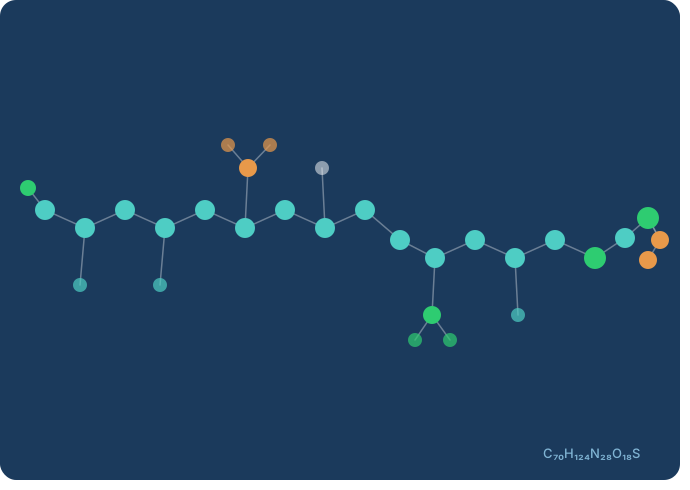
Pentadeca Arginate (PDA) is a synthetic 15-amino acid peptide marketed as an upgraded alternative to BPC-157. It shares a similar sequence to BPC-157 but substitutes arginine at the C-terminus and adds a glycine-arginine extension. Vendors position it as more stable and legally distinct. The research base is thin: no published human trials exist, and animal evidence is early-stage and limited to a small number of studies. Claims of superiority over BPC-157 are not supported by peer-reviewed evidence.
Injectable · Oral
Intranasal Suitable
No
Research Compound
We break down one compound like this every week.
Subscribe free to The Honest Dose, and get the RQS Reference, every compound in the catalog scored on one page, as a welcome gift.
PDA has generated significant online discussion since mid-2024, driven largely by vendors marketing it as a "legal" or "upgraded" alternative to BPC-157. Community reports follow a similar pattern to early BPC-157 anecdotes: tissue repair, gut healing, and systemic anti-inflammatory effects. However, the community signal here is complicated by a vendor-seeded narrative. Unlike BPC-157, whose community signal accumulated organically over years of independent forum discussion, PDA's discourse emerged rapidly alongside commercial launches. This makes it harder to separate genuine user experience from marketing-amplified placebo response. Anecdotal reports should be read with that context in mind.
Pentadeca Arginate is a designer peptide derived from body protection compound (BPC) sequences found in gastric juice. It is a 15-amino acid chain engineered to mimic the proposed tissue-protective activity of BPC-157 while differing in structure at its C-terminal end. PDA entered the market primarily as a regulatory workaround — BPC-157 received an FDA "propose not to include" designation on the 503A Bulks List in 2024, prompting vendors to pivot to structurally related alternatives. PDA does not appear in FDA adverse event databases or registered clinical trials as of this writing.
PDA is proposed to act through similar pathways to BPC-157: upregulation of growth factor signaling (EGF, VEGF), modulation of the nitric oxide pathway, and promotion of angiogenesis and collagen synthesis at sites of injury. The arginine substitution is theorized to enhance nitric oxide production and improve stability relative to BPC-157. These mechanisms are largely extrapolated from BPC-157 animal literature, no published mechanistic human data exists for PDA specifically.
In the research community, PDA is discussed as a potential alternative to BPC-157 for tissue repair, gut health, and systemic healing. Some vendors and online communities promote it for tendon and ligament recovery, gut permeability, and inflammation. All current use cases are extrapolated from BPC-157 animal research and vendor marketing claims, no independent clinical validation for PDA specifically has been published.
No published human safety data exists for PDA. As a novel synthetic peptide with no clinical trial history, its safety profile is unknown. The arginine substitution and extended sequence may produce different receptor interactions and off-target effects than BPC-157. Absence of evidence is not evidence of absence, unknown risk is itself a risk category. Anyone considering research use should recognize this as a compound with a near-zero human evidence base.
PDA is sold primarily as a lyophilized powder for reconstitution and injection (subcutaneous or intramuscular). Oral capsule and liquid formulations are also marketed, though oral bioavailability has not been established in published literature. Nasal administration is not supported by existing evidence. Purity and quality vary significantly between vendors, third-party COA verification is essential given the novel nature of the compound.
PDA has no FDA approval, no Investigational New Drug (IND) application on record, and no registered clinical trials on ClinicalTrials.gov as of July 2026. It emerged commercially following FDA's 2024 "propose not to include" designation for BPC-157 on the 503A Bulks List, positioning it as a structural alternative outside existing regulatory scrutiny. This does not confer legal status, it reflects regulatory novelty, not regulatory approval. Outside the US, no national medicines authority has approved or classified PDA. It occupies a grey market position globally.
Enjoyed this profile? Get one compound broken down in depth every week in The Honest Dose.
Last Reviewed