Metabolic
CAS
1415456-99-3
Molecular Weight
4100
Da
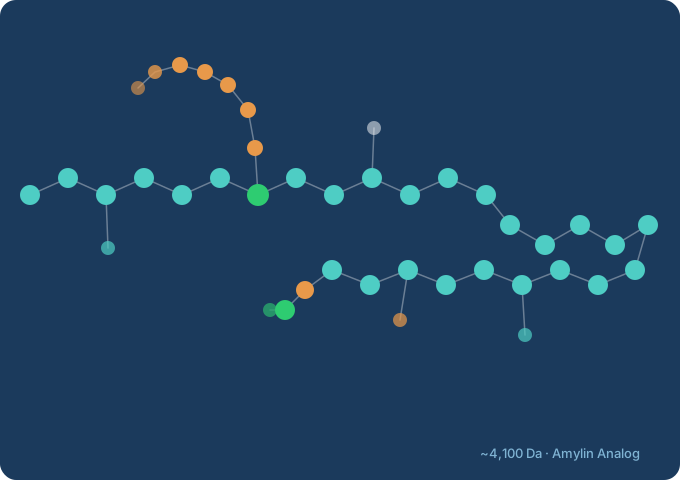
Cagrilintide is a long-acting amylin analog developed by Novo Nordisk, designed for once-weekly subcutaneous injection. It works by mimicking amylin, a pancreatic hormone that regulates appetite and slows gastric emptying. Cagrilintide is being developed primarily in combination with semaglutide (as CagriSema) for obesity and type 2 diabetes. Phase II data is robust; Phase III is complete and CagriSema has been submitted to the FDA. It has not yet received FDA approval as a standalone agent.
Injectable
Intranasal Suitable
No
Emerging / Clinical Trial
We break down one compound like this every week.
Subscribe free to The Honest Dose, and get the RQS Reference, every compound in the catalog scored on one page, as a welcome gift.
Community discussion of cagrilintide is concentrated in GLP-1 and metabolic health forums rather than the peptide research community specifically. Interest spiked following the CagriSema Phase II results, which showed weight loss figures that exceeded semaglutide alone. Discussion centers on the anticipated approval timeline and whether CagriSema will outperform tirzepatide. Research chemical discussion is minimal compared to more established peptides, most community members are waiting for approval rather than sourcing unauthorized versions. Considered a "watch closely" compound across metabolic health forums.
Cagrilintide is a synthetic analog of amylin, the peptide co-secreted with insulin by pancreatic beta cells. Unlike native amylin, which has a half-life of minutes, cagrilintide is engineered with fatty acid conjugation and structural modifications that extend its half-life to approximately 7 days, enabling once-weekly dosing. Novo Nordisk developed it as a complement to GLP-1 receptor agonists, theorizing that dual amylin/GLP-1 action produces additive weight loss beyond either mechanism alone.
Cagrilintide binds amylin receptors (AMY1, AMY2, AMY3) in the hypothalamus and area postrema, reducing appetite and food intake. It also slows gastric emptying, reducing post-meal glucose spikes, and suppresses postprandial glucagon secretion. When combined with semaglutide (CagriSema), the dual mechanism targets appetite through complementary central and peripheral pathways, GLP-1 receptors and amylin receptors, which appear to act additively rather than redundantly based on Phase II data.
Cagrilintide is being investigated for obesity (body weight reduction) and type 2 diabetes management, both as a standalone agent and in combination with semaglutide. Phase II data for CagriSema showed ~15–22% weight loss over 32 weeks depending on dose. It is not approved for any indication as of July 2026 and is not available outside clinical trial or unauthorized research-chemical contexts.
The most commonly reported adverse effects in trials mirror the GLP-1 class: nausea, vomiting, decreased appetite, constipation, and injection site reactions. As an amylin analog, cagrilintide may also carry risks associated with amylin receptor activation in other tissues. Long-term safety data is limited to trial durations (32–72 weeks). Thyroid C-cell effects, a concern for GLP-1 agents, have not been flagged for cagrilintide specifically but remain under evaluation. No approved label exists.
Cagrilintide is administered as a subcutaneous injection, once weekly, in clinical trial settings. It is not commercially available. Research chemical vendors may offer unauthorized versions, but purity, dosing accuracy, and safety in uncontrolled settings cannot be verified. It is being developed as a pre-filled pen device (similar to Ozempic) for anticipated commercial use. The CagriSema fixed-ratio combination (semaglutide + cagrilintide) is the primary commercial target.
Cagrilintide has not received FDA approval as a standalone agent. Its lead development path is the fixed-dose combination with semaglutide, CagriSema, and on December 18, 2025 Novo Nordisk submitted a New Drug Application to the FDA for CagriSema for weight management, based on the pivotal REDEFINE 1 and REDEFINE 2 trials. The FDA is expected to review that application during 2026. CagriSema is not yet approved in the US or EU, and cagrilintide is not on any approved compounding list and cannot be legally prescribed or compounded in the US. Additional REDEFINE and REIMAGINE trials in type 2 diabetes remain ongoing.
Enjoyed this profile? Get one compound broken down in depth every week in The Honest Dose.
Last Reviewed