Growth Hormone
CAS
12629-01-5
Molecular Weight
22124
Da
The body's own growth hormone, produced as a recombinant 191-amino-acid protein. FDA approved for specific deficiency and growth disorders, where the evidence is strong. Widely used off-label for anti-aging, fat loss, and performance, where the evidence is far weaker and the legal status is restrictive.
Injectable
Intranasal Suitable
No
Prescription
We break down one compound like this every week.
Subscribe free to The Honest Dose, and get the RQS Reference, every compound in the catalog scored on one page, as a welcome gift.
Community discussion of HGH is large, long-running, and unusually polarized between "gold standard" enthusiasm and cost/risk skepticism. In longevity and bodybuilding circles it is often treated as the benchmark the rest of the GH-axis compounds (Sermorelin, CJC-1295, Ipamorelin, MK-677) are trying to approximate more cheaply and legally. Reported effects on body composition, skin, and sleep are common, but so are reports of water retention, joint pain, and elevated fasting glucose, and experienced users frequently emphasize that real pharmaceutical product is expensive and that the gray market is saturated with underdosed or counterfeit vials. The most important signal-versus-evidence gap to flag is that the strong research base behind HGH is almost entirely from deficiency populations, while the community use case is healthy adults seeking anti-aging or performance effects, where the controlled evidence is thin and the side-effect rate is high.
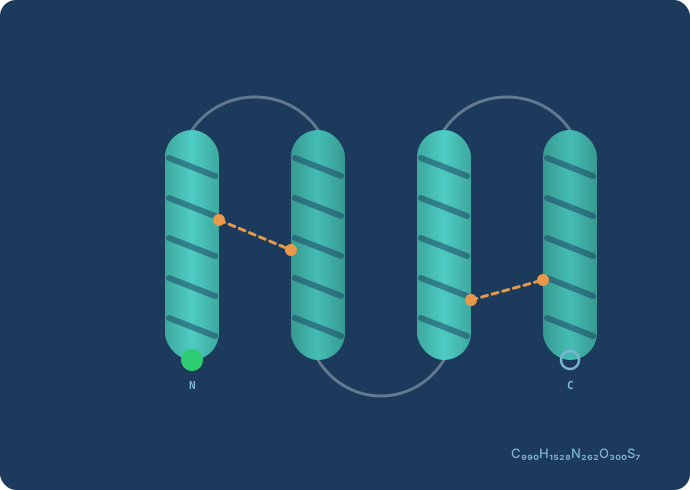
HGH (human growth hormone, generic name somatropin) is a 191-amino-acid protein hormone produced naturally by the pituitary gland and manufactured for therapeutic use through recombinant DNA technology. It is structurally identical to the growth hormone the body makes itself. Unlike most compounds in this catalog, HGH is a large protein rather than a short peptide, and it is an FDA-approved prescription medicine for a defined list of conditions. The same molecule is also one of the most widely diverted substances in the performance and longevity space, which creates a sharp split between its well-studied approved uses and its heavily marketed off-label ones.
HGH binds to the growth hormone receptor on cell surfaces, triggering signaling that drives the liver and other tissues to produce insulin-like growth factor 1 (IGF-1). Most of HGH's downstream effects on tissue growth, bone density, and body composition are mediated by IGF-1. It promotes protein synthesis, lipolysis (fat breakdown), and the retention of nitrogen, and it influences glucose metabolism, often raising insulin resistance at higher exposures. In people who genuinely lack adequate growth hormone, restoring normal levels reverses a clear cluster of deficiency symptoms. In people with normal levels, the picture is far less clear.
HGH is FDA approved for pediatric growth hormone deficiency, adult growth hormone deficiency, Turner syndrome, Prader-Willi syndrome, chronic kidney disease in children, SHOX deficiency, idiopathic short stature, and HIV-associated wasting. Outside these approved indications it is widely used off-label for anti-aging, body recomposition, fat loss, injury recovery, and athletic performance. The evidence supporting these off-label uses is substantially weaker than the evidence behind the approved indications, and most controlled work in healthy adults shows modest body-composition changes accompanied by a high rate of side effects.
In growth-hormone-deficient patients under medical supervision, HGH has a well-characterized safety profile. In healthy adults using it off-label, the risk picture is less favorable. Documented adverse effects include fluid retention and edema, joint and muscle pain, carpal tunnel syndrome, insulin resistance and elevated blood glucose, and gynecomastia. There are theoretical and population-level concerns linking elevated growth hormone and IGF-1 signaling to certain cancers, which is why HGH is used cautiously in anyone with a cancer history. Doses used for performance or anti-aging are typically higher than physiologic replacement and carry correspondingly greater risk. Counterfeit and underdosed product is common in the gray market. Not appropriate during pregnancy or breastfeeding outside specific medical indications.
HGH is administered by subcutaneous injection. Standard formulations require daily dosing; longer-acting analogs such as somapacitan allow once-weekly dosing and are FDA approved for certain indications. There is no oral, sublingual, or intranasal form that delivers intact HGH, because the molecule is far too large and is degraded before absorption. Products marketed as oral or spray "HGH boosters" do not contain bioavailable growth hormone.
HGH occupies a different regulatory position from most compounds in this catalog. As somatropin, it is an FDA-approved prescription drug sold under brand names such as Genotropin, Norditropin, Humatrope, Omnitrope, and Saizen. However, federal law (21 U.S.C. 333(e)) makes it a criminal offense to distribute or possess HGH for any use other than the treatment of a disease or recognized medical condition authorized by the FDA. This means anti-aging, athletic, and general off-label distribution is specifically prohibited, a stricter standard than the gray-market "not for human consumption" status of research peptides. HGH is also banned in essentially all competitive sport by WADA and the major leagues.
https://pubmed.ncbi.nlm.nih.gov/2355952/
https://pubmed.ncbi.nlm.nih.gov/17227934/
https://pubmed.ncbi.nlm.nih.gov/16636129/
Enjoyed this profile? Get one compound broken down in depth every week in The Honest Dose.
Last Reviewed