Immune & Antiviral
CAS
154947-66-7
Molecular Weight
4493
Da
The antimicrobial peptide LL-37 is the only known member of the cathelicidin family of peptides expressed in humans. A naturally occurring 37 amino acid peptide produced by neutrophils, epithelial cells, and immune cells as a frontline defense against infection. LL-37 effectively combats over 38 bacteria, 16 fungi, and 16 viruses through various mechanisms including membrane rupture, targeting, and biofilm suppression. Unlike most compounds in this catalog which work through receptor agonism or gene regulation, LL-37 physically destroys microbial membranes, a fundamentally different mechanism that has generated significant interest as an antibiotic-resistance-proof antimicrobial strategy. No FDA approval. Research compound only with emerging clinical trial activity.
Injectable · Topical
Intranasal Suitable
Uncertain
Research Compound
We break down one compound like this every week.
Subscribe free to The Honest Dose, and get the RQS Reference, every compound in the catalog scored on one page, as a welcome gift.
Community signal is sparse and research-adjacent. LL-37 remains a fringe compound even within peptide communities, discussed primarily in immune health and antimicrobial contexts rather than as a personal use compound. Topical use for skin infections and wound healing generates the most personal reports, though the pool is thin. Injectable use reports are rarer and raise sourcing reliability questions given the technical challenges of producing quality LL-37. The antimicrobial mechanism is well understood within the community that does discuss it, and interest in the innate immunity angle is growing given broader interest in immune optimization. The compound's potential for inflammatory modulation is discussed alongside caution about its potency as a direct antimicrobial.
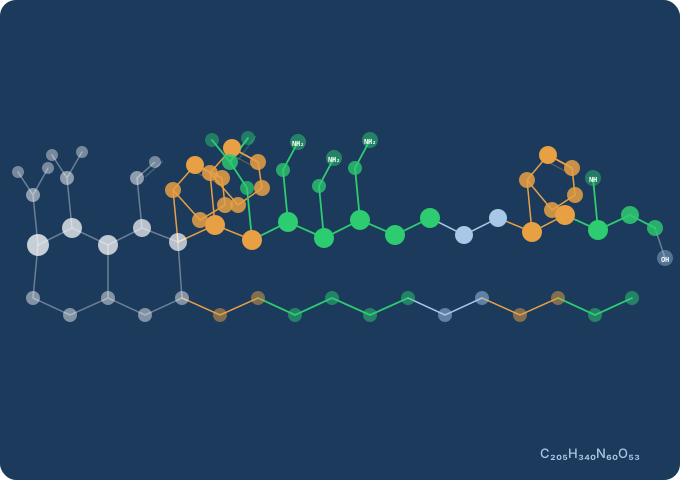
LL-37 is a 37-residue, amphipathic, helical peptide found throughout the body. It is expressed in epithelial cells of the testis, skin, the gastrointestinal tract, and the respiratory tract, and in leukocytes such as monocytes, neutrophils, T cells, NK cells, and B cells. The name "LL-37" derives from its structure, it begins with two leucine residues (LL) and contains 37 amino acids. It is the C-terminal cleavage product of the precursor protein hCAP-18 (human cationic antimicrobial protein-18), which is stored in neutrophil granules and cleaved upon activation to release active LL-37. Cellular production of LL-37 is affected by multiple factors including bacterial products, host cytokines, availability of oxygen, and sun exposure through the activation of CAP-18 gene expression by vitamin D₃. This vitamin D connection explains why vitamin D deficiency is associated with increased susceptibility to respiratory infections, low vitamin D means less LL-37 production in airway epithelium.
LL-37 operates through multiple overlapping mechanisms that make it functionally unique in this catalog. Its primary antimicrobial mechanism is direct membrane disruption, the peptide adopts an amphipathic alpha-helical conformation when it encounters microbial membranes, inserting its hydrophobic face into the lipid bilayer and its cationic face interacting with negatively charged membrane components. This creates toroidal pores or carpet-like membrane dissolution that destroys bacterial integrity. Because this mechanism targets fundamental physical properties of microbial membranes rather than specific proteins, it is extraordinarily difficult for bacteria to develop resistance to, making LL-37 a compelling candidate in the antibiotic resistance crisis.
Beyond direct killing, LL-37 has the ability to prevent immunostimulatory effects of bacterial wall molecules such as lipopolysaccharide and can therefore protect against lethal endotoxemia. Additional activities include chemoattractant function, inhibition of neutrophil apoptosis, and stimulation of angiogenesis, tissue regeneration, and cytokine release. LL-37 inhibits LPS/ATP-induced pyroptosis of macrophages through dual mechanisms, suppressing LPS binding to target cells and ATP-induced P2X7-mediated caspase-1 activation. This anti-pyroptotic activity is particularly relevant to sepsis where uncontrolled macrophage death drives organ failure.
LL-37's most compelling application is antimicrobial defense, its broad-spectrum activity against bacteria, fungi, and viruses that are increasingly resistant to conventional antibiotics makes it a serious candidate for next-generation anti-infective therapy. Chronic wound healing is the most clinically advanced application, with topical LL-37 formulations in clinical trials for diabetic foot ulcers, where its combined antimicrobial and tissue regeneration properties are particularly valuable.
In addition to killing a broad spectrum of microorganisms, LL-37 displays various cellular activities related to inflammation including chemotaxis, epithelial cell activation, angiogenesis, and epithelial wound repair.
Respiratory infections represent a major research focus given LL-37's natural abundance in airway epithelium. Studies have shown reduced LL-37 levels in patients with cystic fibrosis, chronic obstructive pulmonary disease, and COVID-19 severe illness, suggesting LL-37 deficiency as a vulnerability factor. Cancer research is an emerging application, LL-37 shows both pro- and anti-tumor effects depending on cancer type, with anti-tumor activity demonstrated in colorectal, ovarian, and lung cancers via apoptosis induction.
LL-37 has a complex safety profile reflecting its dual role as a host defense molecule. At physiological concentrations it is protective; at supraphysiological concentrations it can be cytotoxic to host cells, the same membrane disruption mechanism that kills bacteria can affect human cells at high doses. This concentration-dependent cytotoxicity is the primary safety concern for systemic administration. LL-37 has gained interest because besides antimicrobial properties, it is an immunomodulator that can contribute to the development of autoimmune diseases. Its ability to form complexes with DNA stimulates plasmacytoid dendritic cells to produce type I IFN, which can drive autoimmune pathology including systemic lupus erythematosus. This autoimmune risk is dose and context dependent. Topical use for wound healing has a more favorable local safety profile. Research compound only, clinical use is limited to ongoing trials.
Available as a lyophilized sterile powder for reconstitution for injectable research use. Topical formulations are in clinical trial development for wound healing applications and represent the most clinically advanced delivery format given the favorable local safety profile compared to systemic administration. The concentration-dependent cytotoxicity of LL-37 makes dose calibration critical for any administration route. Research compound only.
No FDA approval for any indication. Research compound only in most markets. Active clinical trials for chronic wound healing, diabetic foot ulcers, and respiratory infections represent the leading edge of clinical development. Not available through licensed compounding pharmacies in standard practice. Regulatory status varies internationally.
https://pubmed.ncbi.nlm.nih.gov/16716248/
https://pubmed.ncbi.nlm.nih.gov/20049649/
https://pubmed.ncbi.nlm.nih.gov/24454930/
Enjoyed this profile? Get one compound broken down in depth every week in The Honest Dose.
Last Reviewed