Skin & Hair
CAS
49557-75-7
Molecular Weight
340
Da
A naturally occurring copper-bound tripeptide first isolated from human plasma in 1973, with levels declining significantly with age. One of the most biologically active peptides in this catalog, stimulating collagen and elastin synthesis, promoting wound healing, and demonstrating gene expression resetting properties in aging cells. The only peptide in this catalog that spans both mainstream OTC skincare and the gray zone research community. Strong human RCT evidence for topical applications including skin firmness, wrinkle reduction, and hair density.
Topical · Serum
Intranasal Suitable
Yes
OTC Supplement
We break down one compound like this every week.
Every compound scored, on one page, including where GHK-Cu lands. Plus a new breakdown each week.
One of the most enthusiastically discussed peptides in biohacking communities despite thin human RCT evidence, a pattern PeptideClear's RQS framework captures directly. Topical use for skin texture, fine lines, and wound healing generates consistent positive anecdotes. Injectable GHK-Cu reports are more mixed and methodologically harder to evaluate given sourcing variability. Hair loss community (r/tressless and similar) has a significant body of anecdotal discussion, with some users reporting regrowth and others no effect. The gap between community enthusiasm and formal evidence is wider for GHK-Cu than almost any other compound in the catalog.
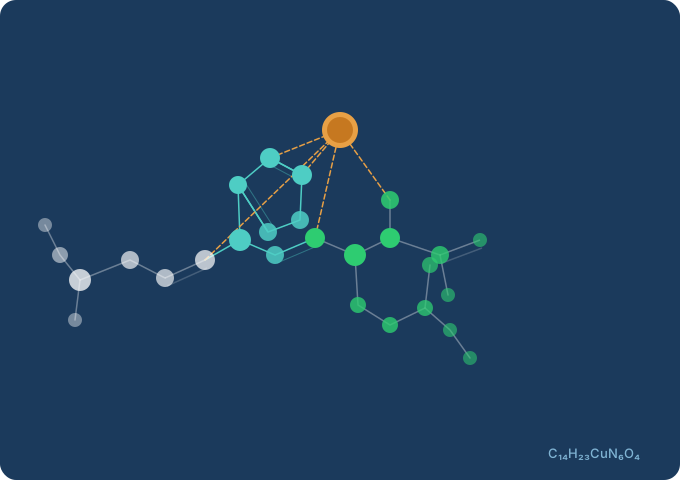
GHK-Cu (Copper Peptide GHK-Cu) is a naturally occurring copper complex consisting of the tripeptide glycyl-L-histidyl-L-lysine bound to a copper ion. It was first isolated from human plasma in 1973 by Dr. Loren Pickart and has since become one of the most extensively studied peptides in skin biology. GHK-Cu occurs naturally in human plasma, saliva, and urine and declines significantly with age — plasma levels drop from approximately 200 ng/mL at age 20 to 80 ng/mL by age 60 — a decline that correlates with the deterioration of skin repair capacity observed in aging. It is unique in that it sits comfortably in both the mainstream OTC skincare market and the more performance-oriented peptide community.
GHK-Cu operates through multiple mechanisms simultaneously making it one of the most biologically active peptides in this catalog. It acts as a potent stimulator of collagen, elastin, and glycosaminoglycan synthesis in fibroblasts. It promotes angiogenesis and nerve outgrowth, activates antioxidant and anti-inflammatory pathways, and has been shown to reset gene expression patterns in aging cells toward a more youthful profile, a remarkable finding that has attracted significant interest in the longevity research community. The copper ion component plays a critical role, it activates enzymes involved in collagen crosslinking and antioxidant defense including superoxide dismutase.
GHK-Cu has strong human evidence for topical applications including reduction of fine lines and wrinkles, improvement of skin firmness and elasticity, acceleration of wound healing, reduction of skin hyperpigmentation, and improvement of hair follicle health and density. It is widely used in premium skincare formulations. Injectable and systemic uses are less studied in humans but are explored in the biohacking community for systemic anti-aging effects, hair regrowth, and wound healing acceleration. Its gene expression resetting properties have made it a significant subject of longevity research.
Topical GHK-Cu has an excellent safety profile and is well tolerated by most skin types including sensitive skin. Some individuals experience mild skin irritation or a temporary blue-green tint from the copper complex at higher concentrations, both are transient and harmless. Injectable use carries the same considerations as other research-grade injectables, no established human safety data for systemic administration, unknown long-term effects, and risk of contamination from unregulated suppliers. Copper toxicity is theoretically possible with excessive systemic use though has not been reported at doses used in research contexts. Not recommended during pregnancy for injectable forms
Topical serum and cream (OTC, widely available in skincare), injectable (research grade, available through research chemical vendors), and increasingly in hair care products including shampoos and scalp serums. The topical form is the most studied, most accessible, and most appropriate for most consumers. Injectable GHK-Cu is at the gray zone end of the catalog.
Topical GHK-Cu is an OTC cosmetic ingredient with no prescription required, it is one of the most common active ingredients in premium anti-aging skincare. Injectable GHK-Cu exists in a research compound gray zone similar to BPC-157 and TB-500. The topical form is regulated as a cosmetic ingredient by the FDA. No prescription pathway currently exists for injectable forms.
https://pubmed.ncbi.nlm.nih.gov/26236730/
https://pubmed.ncbi.nlm.nih.gov/19570099/
https://pubmed.ncbi.nlm.nih.gov/29986520/
Enjoyed this profile? Get one compound broken down in depth every week in The Honest Dose.
Last Reviewed