Nootropics & Neuroprotection
CAS
1401708-83-5
Molecular Weight
320
Da
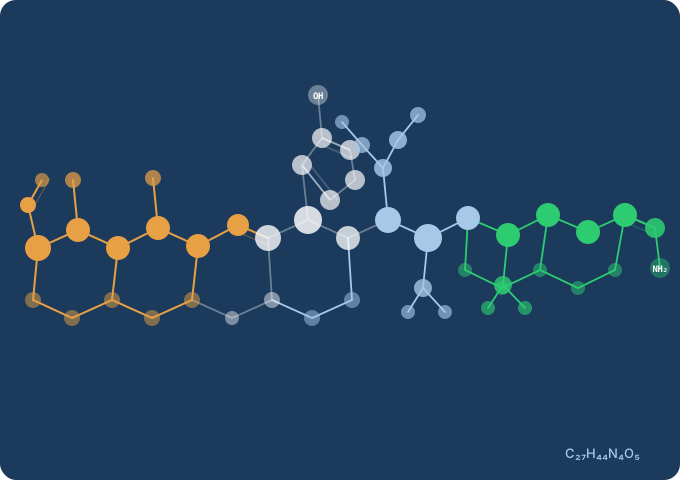
A synthetic six-amino-acid peptide derivative of angiotensin IV developed by Dr. Joseph Harding's lab at Washington State University around 2011. It is unusual among peptides in two ways: it is orally bioavailable, and it crosses the blood-brain barrier. Most peptides cannot do either. Seven orders of magnitude more potent than BDNF in the original synaptogenesis assays — a claim that has generated both excitement and significant scientific scrutiny. Its primary mechanism is activating the hepatocyte growth factor (HGF)/c-Met receptor pathway in the brain, which drives synaptogenesis, the formation of new synaptic connections. No human clinical trials completed. Research compound only.
Oral · Injectable
Intranasal Suitable
Yes
Research Compound
We break down one compound like this every week.
Subscribe free to The Honest Dose, and get the RQS Reference, every compound in the catalog scored on one page, as a welcome gift.
Community signal is small but notably intense for those who report positive effects. Dihexa users tend to describe cognitive enhancement effects as pronounced rather than subtle. Memory and learning enhancement are the primary reported benefits. However, the anecdotal pool is thin enough that selection bias toward positive reporters is a real concern. r/Nootropics discussions flag the potency of the compound with corresponding caution about unknown long-term effects. Some sophisticated users raise the c-Met/HGF mechanism and the theoretical concern about promoting cell growth, a caveat that appears in the community more than for most nootropic compounds. Dosing uncertainty is significant given limited human pharmacokinetic data.
Dihexa is a synthetic, metabolically stabilized analog of angiotensin IV developed by Joseph W. Harding, PhD at Washington State University. Angiotensin IV is a fragment of the renin-angiotensin hormone system that regulates blood pressure, its presence in the brain and its cognitive effects were largely overlooked until Harding's laboratory systematically mapped its neurological activity. Dihexa was engineered by modifying Ang IV to dramatically improve stability, potency, and blood-brain barrier penetration. Dihexa has essentially no safety data beyond behavioral studies in rodents, which is the most important caveat for one of the most potent nootropic compounds in the catalog. A notable 2026 development: the April 22, 2026 FDA Category 2 removal represents a meaningful regulatory shift worth monitoring, PeptideClear will update this profile as the regulatory situation develops.
Dihexa is an orally active and blood-brain barrier-permeable analog of angiotensin IV. It binds to hepatocyte growth factor (HGF) with high affinity and potentiates its activity at its receptor, c-Met. The HGF/c-Met pathway is one of the primary drivers of synaptogenesis, the physical formation of new synaptic connections between neurons. This is mechanistically distinct from every other nootropic compound in the catalog: Semax upregulates BDNF expression, Selank modulates GABA-A receptors, Humanin inhibits apoptosis, but Dihexa directly stimulates the physical construction of new neural architecture.
The "10 million times more potent than BDNF" claim applies to a specific in vitro assay (spine induction) and does not directly translate to cognitive superiority over other nootropics in vivo. This is an important distinction, in vitro potency numbers are frequently cited in the community without this context, leading to significant overstatement of what the data actually shows. PeptideClear presents the claim accurately: extraordinary potency in a specific laboratory assay, with unknown translation to human cognitive outcomes.
Dihexa has an extremely long half-life of 12.7 days in rats, requiring infrequent dosing, an unusual pharmacokinetic property that distinguishes it from most nootropic peptides and has significant implications for dosing protocols and safety monitoring.
Dihexa's primary studied application is cognitive enhancement and neurodegeneration, specifically Alzheimer's disease. Animal studies demonstrate meaningful improvements in spatial memory, learning acquisition, and cognitive performance in aged rats and in rodent models of Alzheimer's disease. Dihexa can enhance cognitive function in rats and protect neurons from apoptosis, suggesting potential applications in the treatment of neurodegenerative diseases such as Alzheimer's and Parkinson's disease.
In the nootropic community Dihexa is used for cognitive enhancement, memory improvement, and neuroplasticity. The oral bioavailability and blood-brain barrier penetration make it uniquely practical among nootropic peptides, most require injection. The extremely long half-life means effects, both beneficial and potentially adverse, persist long after dosing ceases.
Traumatic brain injury recovery is an emerging research application given the synaptogenesis mechanism, rebuilding neural connections damaged by injury is a theoretically compelling use case that remains preclinical only.
Dihexa's safety profile is the most concerning of any compound in the Nootropics & Neuroprotection category. Potency: In preclinical studies, Dihexa was shown to be millions of times more potent than BDNF at stimulating synaptogenesis. This means very small amounts may have strong biological effects. The HGF/c-Met pathway that drives synaptogenesis is also a known oncogenic pathway, c-Met overactivation is associated with multiple cancers. Chronic stimulation of this pathway carries a theoretically meaningful cancer risk that has not been studied in long-term animal models, let alone humans. Dihexa has essentially no safety data beyond behavioral studies in rodents, the knowledge gap between its potency profile and its safety characterization is the widest of any compound currently covered on PeptideClear. Users in the biohacking community report both cognitive benefits and concerning effects including emotional blunting and cognitive rigidity with chronic use. Research compound only.
Dihexa has been tested in oral formulations and subcutaneous injections. Unlike many peptides, it can cross the blood-brain barrier when taken orally. Available as lyophilized powder for reconstitution or oral capsule formulations through research compound suppliers. The extremely long half-life of 12.7 days in rats requires infrequent dosing, this property makes dose calibration particularly important as accumulation with repeated dosing is a meaningful concern. Research compound only.
April 22, 2026 FDA Category 2 removal represents an evolving regulatory situation that PeptideClear is monitoring. Previously a research compound with no regulatory pathway. Not available through licensed compounding pharmacies under standard practice. The combination of extraordinary potency, minimal safety data, and an active oncogenic pathway mechanism makes Dihexa one of the compounds where PeptideClear most strongly emphasizes the research-only designation.
https://pmc.ncbi.nlm.nih.gov/articles/PMC3533412/
https://pubmed.ncbi.nlm.nih.gov/36683507/
https://pmc.ncbi.nlm.nih.gov/articles/PMC3186286/
Enjoyed this profile? Get one compound broken down in depth every week in The Honest Dose.
Last Reviewed